Tixel
Tixel is a new non-laser fractional system of skin resurfacing that is based on thermomechanical ablation technology. Using the heat energy, when the tip of the TIXEL touches the skin it causes micro injuries. These micro injuries encourage the body to produce collagen and elastin for a more healthy and supple skin. TIXEL can be used all over the face, including the sensitive skin around the eyes and the neck and that’s why it is the preference of many skin specialists like Dr. Nivedita Dadu.
How is Tixel different from Lasers?
LASERS are a technology based on light. The light from the lasers interacts with the skin and causes effects by heating the skin. TIXEL is based on heat. Tixel transfers heat directly to the skin itself with its patented titanium tips.
Why is Tixel better than Traditional CO2 Lasers?
-
Tixel is a is a non-invasive and comfortable treatment for rejuvenating the skin uses pure heat energy and gives results that are similar to CO2 lasers in return but takes significantly less downtime.
-
Tixel and traditional CO2 lasers work similarly, both deliver pure heat energy to the skin and similar results but TIXEL does not cause the same amount of damage to the internal layers of the skin as lasers.
-
Tixel micropores are free from necrotic tissue unlike the typical micropores present in fractional C02 lasers.
Benefits of Tixel technology for rejuvenating the skin
1. Non-invasive treatment for skin rejuvenation
2. Less pain, low downtime, and rapid healing
3. Transfer of thermal energy to the skin creates micro-craters by evaporation.
4. Safe treatment without sacrificing efficacy
5. Tixel can perform both ablative and non-ablative treatments
How does TIXEL work?
TIXEL uses a Titanium tip with tiny pins made of biocompatible material, having a pyramid like a shape with small contact points which are about 20 microns in size and cover a treatment area of 1cm². The pins are heated to a temperature of 400°C, as similar to the temperature usually generated by other fractional CO? laser beams. The thermal energy stored in the pins is quickly transferred to the skin that will last only a few milliseconds, through a prefixed contact time and contact depth. It can be used at different depths and with different contact times that helps TIXEL to deliver different and effective results.
Using medium penetration and a high contact time that allows TIXEL to work like an ablative laser. It is an ideal solution for giving good improvements in acne scars, stretch marks or fine lines of the skin. It also allows TIXEL for tightening the skin and to treat open pores and fine lines. Using very short contact and very superficial penetration that will help to make open channels in the skin through which actives like (anti aging creams, anti pigmentation creams,Collagen Induction Therapy) and medicines can be easily delivered.
The thermal energy is transferred safely and quickly as compared to the traditional CO2 lasers and the subsequent evaporation of water from the skin occurs resulting in the formation of tiny micropores in the treated sites. This evaporates the upper layers in a controlled manner so that there will be no chance of burns in the tissue. Using pure heat energy, the tip of the Tixel machine partially touches the skin which causes neat, clean micro-injuries.
Where can be TIXEL be used?
Tixel can be used for following treatments because of the different depths and methods of actions such as-
-
Acne scars
-
Open pores
-
Fine lines
-
Skin laxity or skin tightening
-
Skin Rejuvenation
-
Stretch marks
-
Skin resurfacing of moderate to severe wrinkles on the face, upper lips, crow’s feet, cheeks, glabella, forehead, perioral region, full-face, neck, décolleté and hands.
Results
TIXEL is based on pure heat energy. It helps to transfer the heat directly to the skin itself with its patented titanium tips. The advantage of Tixel is that there are no side effects to the eye, so no additional eye protection is required following the procedure. Patients most commonly experience a warm sensation in the target area similar to a sunburn, which will settle down after about an hour following the treatment.The treatment tip at the contact point is only 20 microns, so the down time or redness post treatment lasts less than 48 hours. Also, the post treatment marks are very light in color and can be covered with a tinted sunscreen/makeup.This means the treated persons can go back to their daily work the very next day. It is typically a weekend treatment.
For Tixel Treatment, Visit at Dadu Medical Centre located in Delhi, Vasant Vihar (South Delhi), Rajouri Garden (West Delhi).
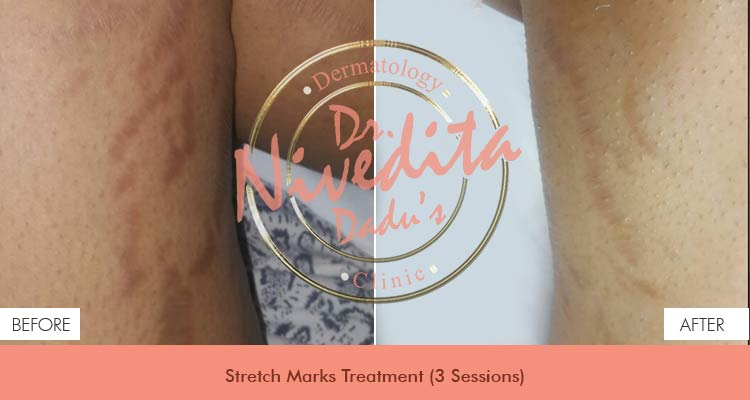 * Results may vary person to person.
Tixel Treatment for Stretch Marks in Delhi – Heat-Based Skin Resurfacing at Dadu Medical Centre
Stretch marks are something a large number of people deal with silently whether from pregnancy, sudden weight changes, a growth spurt, or hormonal shifts and finding a treatment that actually makes a visible difference without requiring days of recovery has been a challenge for a long time. Tixel thermomechanical stretch mark treatment in Delhi at Dadu Medical Centre is one of the newer options that has changed that conversation. Tixel is not a laser. That is one of the first and most important things to understand about it. Most people who come in for a consultation have tried or heard about laser treatments, but Tixel works on a completely different principle: pure heat energy transferred directly from a titanium tip to the skin surface through physical contact, in millisecond bursts. The titanium tip is fitted with tiny pyramid-shaped biocompatible pins, each with a contact point of just 20 microns, covering an area of one square centimetre at a time. These pins are pre-heated to a temperature of 400 degrees Celsius which is comparable to what fractional CO2 lasers reach and when the handpiece is briefly pressed against the skin in a controlled stamping motion, the thermal energy passes from the tip into the skin in a fraction of a second. The contact time is so brief that the heat does not spread widely but instead stays precisely within the treatment zone, creating fractional micro-injuries in the skin that trigger the body's natural repair process. This leads to the production of new collagen and elastin in the treated area the structural proteins that give skin its firmness and elasticity and over multiple sessions these proteins rebuild and remodel the skin tissue within and around the stretch marks, gradually making them less visible, less depressed, and more even in colour and texture. At Dadu Medical Centre, one of the established stretch mark treatment clinics in Delhi, Dr. Nivedita Dadu uses Tixel as a preferred option for patients who want results comparable to ablative laser treatment but with significantly less downtime. The clinic is located at Vasant Vihar in South Delhi and Rajouri Garden in West Delhi, and Tixel stretch mark sessions are performed under full medical supervision with treatment parameters customised for each patient.
What makes Tixel particularly practical as a stretch mark treatment in Delhi is its adjustability and its safety profile. Unlike light-based lasers, Tixel does not emit any radiation that could pose a risk to the eyes, which means no special eye protection equipment is required and the skin around the eyes and on the neck can be treated without concern. More importantly, the contact time and contact depth of the titanium tip can be adjusted; this means the same device can be set to work at different intensities depending on what the patient's skin needs. At a lighter setting with short contact time and shallow depth, Tixel functions like a non-ablative treatment, warming the dermis and stimulating collagen without any visible surface disruption. At a medium depth setting with a longer contact time, it behaves more like an ablative laser, creating micro-channels on the skin surface that drive stronger and faster collagen remodelling. For stretch marks, this adjustability is particularly valuable. Newer, redder stretch marks that are still in an active inflammatory phase tend to respond well to lighter settings and may need fewer sessions. Older, white, depressed stretch marks require a more intensive approach that drives deeper collagen rebuilding, and the medium setting delivers that without the kind of downtime associated with traditional ablative laser treatments. Patients most commonly feel a warm sensation in the treated area that is similar to a mild sunburn — this typically settles within an hour following the session. Because the contact point of each pin is only 20 microns, the post-treatment redness and any visible marks are very light in colour and settle in less than forty-eight hours. They can also be covered with a tinted sunscreen or makeup after the appropriate settling time, which means many patients treat Tixel as a weekend treatment done on a Friday or Saturday and back to normal life by Monday without anyone noticing.
The session at the stretch mark treatment clinic in Delhi at Dadu Medical Centre begins with the skin being thoroughly cleansed to remove any products, oil, or surface debris from the area to be treated. A numbing cream is applied and left for thirty to forty-five minutes to ensure the patient is comfortable throughout the procedure. Once the skin is numb, the Tixel handpiece is systematically applied across the stretch marks in a controlled stamping pattern. The preset protrusion depth and contact time are used consistently throughout the session to deliver even, reproducible results across the entire treatment area. The session typically takes thirty to forty-five minutes depending on the size of the area. After the session, a soothing post-care product is applied to calm the treated skin, followed by a broad-spectrum sunscreen. Patients are asked to avoid direct sun exposure on the treated area for a few days, keep the skin moisturised with a gentle product, and refrain from using any harsh exfoliating actives for the first few days post-session. The redness and warmth usually settle well within the first twenty-four to forty-eight hours, and the skin simply looks slightly flushed for a short time before returning to its normal appearance. The real improvement happens quietly beneath the surface over the following weeks, as the newly triggered collagen builds up and the skin tissue around the stretch marks gradually remodels and improves.
Most patients need three to five sessions of Tixel for stretch marks, spaced about three to four weeks apart to give the skin adequate time to heal and regenerate between treatments. Newer, red stretch marks may respond in fewer sessions while older, white, more established stretch marks typically need the full course and may show more gradual improvement over a longer period. Dr. Nivedita Dadu evaluates the age, colour, depth, location, and size of each patient's stretch marks during the initial consultation and builds a treatment plan accordingly. The depth of Tixel's settings can also be adjusted upward over subsequent sessions as the skin builds tolerance and the treating doctor assesses how the skin is responding. For patients who want more dramatic or faster results, Tixel can be combined with MNRF or Erbium Fibre Laser as part of a multi-modality plan designed by the stretch mark doctors in Delhi at Dadu Medical Centre. Consistent aftercare, sun protection, and keeping the skin well-moisturised between sessions are all important in getting the best outcome from the treatment. If you have been looking for an effective, low-downtime stretch mark treatment in Delhi that you can fit around your routine without taking time off, Tixel at Dadu Medical Centre is worth discussing at a consultation.
Tixel Stretch Mark Treatment Cost in Delhi
|
Treatment Plan |
Approx. Cost Per Session |
Sessions Usually Needed |
Best For |
|
Single Session |
Rs. 4,000 – Rs. 10,000 |
1 |
Trial / small area or mild stretch marks |
|
Basic Course |
Rs. 4,000 – Rs. 10,000 per session |
3 – 4 sessions |
New / mild to moderate stretch marks |
|
Standard Course |
Rs. 4,000 – Rs. 10,000 per session |
4 – 5 sessions |
Moderate to older established stretch marks |
|
Combined Plan (Tixel + MNRF / Erbium Laser) |
Rs. 6,000 – Rs. 15,000 per session |
As advised by doctor |
Deep, extensive, or stubborn stretch marks |
Prices are approximate. Final cost is confirmed after stretch mark assessment and consultation at the clinic.
Tixel Treatment Intensity Levels for Stretch Marks
|
Mode |
Contact Time |
Depth |
What Happens in Skin |
Best For |
|
Light / Non-Ablative |
Short |
Shallow |
Dermis warmed, collagen stimulated, no surface disruption |
New red stretch marks, first-time patients |
|
Medium / Semi-Ablative |
Medium |
Medium |
Micro-channels formed, strong collagen remodelling |
Moderate and mixed stretch marks |
|
Higher / Ablative-Like |
Longer |
Deeper |
Stronger tissue remodelling, faster collagen response |
Older white or deeper stretch marks |
Mode is selected by the doctor after assessing the age, depth, and severity of the stretch marks.
Tixel for Stretch Marks – Recovery and Results Timeline
|
Phase |
Timeframe |
What to Expect |
|
During Session |
30 – 45 minutes |
Controlled heat applied in stamping motion, mild warmth felt |
|
Immediately After |
0 – 1 hour |
Warm sensation similar to mild sunburn, settles within an hour |
|
Post-Treatment Redness |
24 – 48 hours |
Very light redness, can be covered with tinted sunscreen or makeup |
|
Return to Normal Activity |
Next day |
Skin appears normal, internal repair begins quietly |
|
Early Collagen Building |
Weeks 2 – 4 |
Internal repair underway, subtle texture changes begin |
|
After Session 2 – 3 |
Month 2 – 3 |
Visible colour improvement, marks appear less depressed |
|
After Full Course |
Month 4 – 6 |
Maximum improvement in texture, depth, and colour of stretch marks |
Results vary based on stretch mark type, age, depth, location, and consistency of aftercare.
Frequently Asked Questions (FAQs)
Q. What is Tixel and how is it different from lasers for stretch marks?
Ans. Tixel transfers heat directly to the skin through a titanium tip rather than using laser light, giving similar results to CO2 laser treatment but with significantly less downtime.
Q. Is Tixel treatment for stretch marks painful?
Ans. Most patients feel a warm sensation similar to a mild sunburn during the session, which settles within about an hour after the procedure.
Q. How many Tixel sessions are needed for stretch marks in Delhi?
Ans. Most patients need three to five sessions spaced three to four weeks apart depending on the age, type, and severity of the stretch marks.
Q. Is there any downtime after Tixel stretch mark treatment?
Ans. Downtime is less than forty-eight hours. The mild redness can be covered with tinted sunscreen or makeup and most patients return to normal work the next day.
Q. What is the cost of Tixel stretch mark treatment in Delhi?
Ans. The approximate cost ranges from Rs. 4,000 to Rs. 10,000 per session. The final amount is confirmed after a stretch mark assessment at the clinic.
Q. Can Tixel treat both new red and old white stretch marks?
Ans. Yes, the treatment intensity can be adjusted based on stretch mark type newer red marks and older white marks are both treatable with different settings.
Q. Is Tixel safe for all skin tones including Indian skin?
Ans. Yes, Tixel does not rely on light absorption so it is safe across all skin tones including darker Indian skin without the risk of pigmentation issues associated with some lasers.
Q. Can Tixel be used on the abdomen, thighs, and other body areas?
Ans. Yes, Tixel can be applied on the abdomen, thighs, breasts, hips, lower back, and any other area where stretch marks are present.
Q. Is Tixel a good treatment if I cannot take time off for recovery?
Ans. Yes, Tixel is often called a weekend treatment because patients can resume work and daily activities within twenty-four to forty-eight hours after the session.
Q. Which clinic in Delhi should I visit for Tixel stretch mark treatment?
Ans. Dadu Medical Centre in Vasant Vihar and Rajouri Garden, led by Dr. Nivedita Dadu, is a trusted stretch mark treatment clinic in Delhi offering Tixel under expert dermatological supervision.